The Great Fire
Author/Illustrator: Jim Murphy
Awards: Newbery Honor (1996)
Genre: Nonfiction
Grade Level: 4-6
This book informs readers about the famous Chicago fire. The author tells readers about how the fire was started when a cow kicked over a bucket. Because the entire city was built out of wood, the fire continued to spread. By the time the fire had been doused, Chicago had to face new problems, including homelessness.
This book includes both photographs and drawings. They are realistic and may be frightening to younger readers, but the dramatic flames will keep older and more daring students engaged.
This story is a great informational text about an iconic historical event. Students can also learn valuable lessons from this book, such as how to prevent catastrophic events in the future and how to be safe in the event of a fire.
Showing posts with label nonfiction. Show all posts
Saturday, December 3, 2016
The Fruits We Eat by Gail Gibbons
The Fruits We Eat
Author/Illustrator: Gail Gibbons
Genre: Nonfiction
Awards: N/A
Grade Level: K-2
The book informs readers of all the different fruits and how they grow.
Unlike many nonfiction books, this story includes illustrations rather than photographs. The illustrations are realistic and the fruits are recognizable by even young readers.
This story will teach students about where our food comes from. Teachers can use this book for many reasons including science and the study of seeds and growth, as well as economics and how the fruits get from the ground to our plates.
Author/Illustrator: Gail Gibbons
Genre: Nonfiction
Awards: N/A
Grade Level: K-2
The book informs readers of all the different fruits and how they grow.
Unlike many nonfiction books, this story includes illustrations rather than photographs. The illustrations are realistic and the fruits are recognizable by even young readers.
This story will teach students about where our food comes from. Teachers can use this book for many reasons including science and the study of seeds and growth, as well as economics and how the fruits get from the ground to our plates.
Wednesday, November 30, 2016
Balloons over Bradway by Melissa Sweet
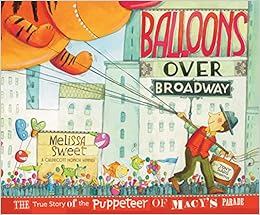
Balloons over Broadway: The True Story of the Puppeteer of Macy's Parade
Author/Illustrator: Melissa Sweet
Awards: Caldecott Award
Genre: Nonfiction (biography)
Grade Level: PK- 2
Even as a child, Tony Sarg was always trying to make things move. He even built contraptions to do his chores for him! When he grew up, he moved to London and noticed that children didn't have any puppets, so he began to make them for all the children. Eventually his puppets were used in Broadway productions. Macy's asked him to design puppets for their windows, and he used cartoon characters for his inspiration. As the holidays approached, Macy's decided to provide a parade for their employees and Tony was hired to replace the scary animals with more friendly characters. This became an annual event to entertain guests on Thanksgiving. Tony continued to improve his balloons each year.
I love the nontraditional illustrations in this story. On every page their is something unique, including diagrams, sketches, parade routes, and even puppets that look like they are laying on the page.
This book would be especially useful around Thanksgiving when sone students may be watching the parade at home. Students can learn a lot about the time period of this story. The illustration include older phones, streets, buildings, and of course, puppets. Students can appreciate the hard work Tony Starg put into his designs, especially without the use of the modern technology that we have now.
Author/Illustrator: Melissa Sweet
Awards: Caldecott Award
Genre: Nonfiction (biography)
Grade Level: PK- 2
Even as a child, Tony Sarg was always trying to make things move. He even built contraptions to do his chores for him! When he grew up, he moved to London and noticed that children didn't have any puppets, so he began to make them for all the children. Eventually his puppets were used in Broadway productions. Macy's asked him to design puppets for their windows, and he used cartoon characters for his inspiration. As the holidays approached, Macy's decided to provide a parade for their employees and Tony was hired to replace the scary animals with more friendly characters. This became an annual event to entertain guests on Thanksgiving. Tony continued to improve his balloons each year.
I love the nontraditional illustrations in this story. On every page their is something unique, including diagrams, sketches, parade routes, and even puppets that look like they are laying on the page.
This book would be especially useful around Thanksgiving when sone students may be watching the parade at home. Students can learn a lot about the time period of this story. The illustration include older phones, streets, buildings, and of course, puppets. Students can appreciate the hard work Tony Starg put into his designs, especially without the use of the modern technology that we have now.
Salt in His Shoes: Michael Jordan in Pursuit of a Dream by Deloris Jordan and Roslyn M. Jordan
Authors: Deloris Jordan, Roslyn M. Jordan
Illustrator: Kadir Nelson
Awards: N/A
Genre: Nonfiction (biography)
Grade Level: PK-2
When he was a child, Michael loved to play basketball with his brothers. He was feeling discouraged because he did not think he was tall enough to be a good basketball player. When he asked his mother how he could get taller, she told him to put salt in his shoes. Although puzzled, Michael listened to his mother and remained patient and said his prayers every night. When Michael was asleep, his mother would put salt in his shoes and say a prayer for him. Michael practiced playing basketball every day. His hard work and determination, along with the help of the salt and prayers, resulted in Michael becoming one of the best basketball players ever.
The illustrations are colorful and intricate. They really bring readers to the neighborhood basketball court where Michael Jordan learned to play.
Although students interested in sports will find this story interesting, the best use for this book is to introduce moral values to readers. Classes can discuss how hard work, patience, and perseverance can pay off in the end.
Authors: Deloris Jordan, Roslyn M. Jordan
Illustrator: Kadir Nelson
Awards: N/A
Genre: Nonfiction (biography)
Grade Level: PK-2
When he was a child, Michael loved to play basketball with his brothers. He was feeling discouraged because he did not think he was tall enough to be a good basketball player. When he asked his mother how he could get taller, she told him to put salt in his shoes. Although puzzled, Michael listened to his mother and remained patient and said his prayers every night. When Michael was asleep, his mother would put salt in his shoes and say a prayer for him. Michael practiced playing basketball every day. His hard work and determination, along with the help of the salt and prayers, resulted in Michael becoming one of the best basketball players ever.
The illustrations are colorful and intricate. They really bring readers to the neighborhood basketball court where Michael Jordan learned to play.
Although students interested in sports will find this story interesting, the best use for this book is to introduce moral values to readers. Classes can discuss how hard work, patience, and perseverance can pay off in the end.
Mr. Ferris and His Wheel by Kathryn Gibbs Davis
Mr. Ferris and His Wheel
Author: Kathryn Gibbs Davis
Illustrator: Gilbert Ford
Awards: N/A
Genre: Nonfiction (biography)
Grade Level: K-2 grade
George Washington Gale Ferris Jr. was an engineer who had big dreams. He design for the Ferris wheel won a contest as his attempt to out-shine the Eiffel Tower after the previous years wold fair. Despite many hardships in the design process as well as unsupportive peers, the Ferris wheel appeared at the 1893 World Fair and has since become an iconic attraction for many amusement parks.
The illustrations are full of vibrant blues and purples. The details in the Ferris wheel, such as the geometric shape and bright lights, transport readers to a different time.
Young readers will learn a lot about where their favorite attraction came from and how it was invented. This underdog story may inspire students to think of new ideas themselves.
Author: Kathryn Gibbs Davis
Illustrator: Gilbert Ford
Awards: N/A
Genre: Nonfiction (biography)
Grade Level: K-2 grade
George Washington Gale Ferris Jr. was an engineer who had big dreams. He design for the Ferris wheel won a contest as his attempt to out-shine the Eiffel Tower after the previous years wold fair. Despite many hardships in the design process as well as unsupportive peers, the Ferris wheel appeared at the 1893 World Fair and has since become an iconic attraction for many amusement parks.
The illustrations are full of vibrant blues and purples. The details in the Ferris wheel, such as the geometric shape and bright lights, transport readers to a different time.
Young readers will learn a lot about where their favorite attraction came from and how it was invented. This underdog story may inspire students to think of new ideas themselves.
Who was Dr. Suess? by Janet B. Pascal
Who was Dr. Suess?
Author: Janet B. Pascal
Illustrator: Nancy Harrison
Awards: N/A
Genre: Nonfiction (Biography)
Grade Level: 2-5 grade
Ted Geisel, who is better known for his pen name "Dr. Suess," loved to create doodles as a child. His mom made up rhymes and his dad ran a zoo. He liked to look at the funny ears on the animals. He also loved funny hats. He would even throw parties at his house where everyone who attended wore crazy hats. His favorite time to wear funny hats was when he was writing his stories. He created many children's books that are iconic and popular around the world.
Although the illustrations are all black and white, they are still interesting even to young readers. As seen in the cover, the illustrations are similar to a caricature and bring Dr. Suess to life.
This biography would pair excellently with any of Dr. Suess's impressive stories. I think students would find it both interesting and informative to learn about the author of the books they love. Students can also talk about the things that inspired Dr. Suess as a writer, such as the zoo animals, and think about things in their life that inspire them.
Friday, November 25, 2016
Families by Ann Morris
Families
Author: Ann Morris
Genre: Multicultural (Nonfiction)
Awards: NA
Grade level: 1-2nd grade
Everyone is part of a family, but each family looks different. Some children live with parents, grandparents, or foster parents. Some children have siblings. Some families have pets. Families are all different, but they all love and care for each other.
Although no photographer is listed, the photographs provide realistic images of different cultures around the world. The families includes in the pictures are diverse and interesting.
This story would be useful in social studies units about families, communities, or culture. Each student will have something to relate to as the book even includes special situations like step-parents and adoptions.
Author: Ann Morris
Genre: Multicultural (Nonfiction)
Awards: NA
Grade level: 1-2nd grade
Everyone is part of a family, but each family looks different. Some children live with parents, grandparents, or foster parents. Some children have siblings. Some families have pets. Families are all different, but they all love and care for each other.
Although no photographer is listed, the photographs provide realistic images of different cultures around the world. The families includes in the pictures are diverse and interesting.
This story would be useful in social studies units about families, communities, or culture. Each student will have something to relate to as the book even includes special situations like step-parents and adoptions.
Sunday, October 23, 2016
Toxic Beasts by Vicky Willows
Toxic Beasts
Author: Vicky Willows
Genre: Nonfiction
Awards: N/A
Grade level: 3-5
Summary: This informative reader begins by introducing readers to "smart words." The book defines smart words as "frequently used words that are critical to understanding concepts taught in the classroom." The purpose of this book is to inform readers about deadly sea creatures, lethal snakes and amphibians, and toxic spiders and ants. Beginning with sea creatures, the author explains the difference between venom and poison and uses pufferfish and snakes as examples. The dangers of certain jellyfish, octopus, and other fish are expressed while also describing their habitats, attack methods, and defenses. In the snakes and amphibians portion, the author discusses different types of snakes and what each organ is used for. She even provides facts for where certain snakes and frogs are located. In the final spiders and ants chapter, readers will learn about identifying spiders and ant colonies.
Evaluation: This book is perfect for introducing science to students. I love the smart word aspect of the book because it highlights words that students may not know and provides a clear definition for each of them. Each word is included in the glossary at the end. At the end of each chapter, there is a short series of questions to review the material. I plan to use this book and many others from the series in classrooms with older students. This is because the topic may not be appealing or appropriate to younger readers because the author uses complex vocabulary words and is very descriptive when discussing how terrifying each beast is. Students can also discuss which of these creatures are found locally and which are found in other countries around the world.
Author: Vicky Willows
Genre: Nonfiction
Awards: N/A
Grade level: 3-5
Summary: This informative reader begins by introducing readers to "smart words." The book defines smart words as "frequently used words that are critical to understanding concepts taught in the classroom." The purpose of this book is to inform readers about deadly sea creatures, lethal snakes and amphibians, and toxic spiders and ants. Beginning with sea creatures, the author explains the difference between venom and poison and uses pufferfish and snakes as examples. The dangers of certain jellyfish, octopus, and other fish are expressed while also describing their habitats, attack methods, and defenses. In the snakes and amphibians portion, the author discusses different types of snakes and what each organ is used for. She even provides facts for where certain snakes and frogs are located. In the final spiders and ants chapter, readers will learn about identifying spiders and ant colonies.
Evaluation: This book is perfect for introducing science to students. I love the smart word aspect of the book because it highlights words that students may not know and provides a clear definition for each of them. Each word is included in the glossary at the end. At the end of each chapter, there is a short series of questions to review the material. I plan to use this book and many others from the series in classrooms with older students. This is because the topic may not be appealing or appropriate to younger readers because the author uses complex vocabulary words and is very descriptive when discussing how terrifying each beast is. Students can also discuss which of these creatures are found locally and which are found in other countries around the world.
Thursday, October 6, 2016
Autumn Leaves by Ken Robbins
Autumn Leaves
Author: Ken Robbins
Genre: Nonfiction
Awards:N/A
Grade level: k-1
Summary: In this descriptive book about fall leaves, the writer uses life-size photographs of different leaves to identify what type of tree it came from. There many different shapes and sizes of leaves, even leaves that come from the same tree. Before the leaves fall off of the tree every autumn, the leaves change from green to orange and red. There are many fun facts about the history of each tree.
The book uses real photographs of life size leaves to help students see what the actual leaves look like
Evaluation: Students can compare the shapes of leaves to shapes that they are already familiar with. Although the author does not mention this, learners can discuss why the leaves change colors. This book will also be useful when learning about weather, as students can identify which season it is based on the color of the leaves.
Author: Ken Robbins
Genre: Nonfiction
Awards:N/A
Grade level: k-1
Summary: In this descriptive book about fall leaves, the writer uses life-size photographs of different leaves to identify what type of tree it came from. There many different shapes and sizes of leaves, even leaves that come from the same tree. Before the leaves fall off of the tree every autumn, the leaves change from green to orange and red. There are many fun facts about the history of each tree.
The book uses real photographs of life size leaves to help students see what the actual leaves look like
Evaluation: Students can compare the shapes of leaves to shapes that they are already familiar with. Although the author does not mention this, learners can discuss why the leaves change colors. This book will also be useful when learning about weather, as students can identify which season it is based on the color of the leaves.
Bull Shark by Deborah Nuzzolo
Bull Shark
Author: Deborah Nuzzolo
Genre: Nonfiction
Awards:N/A
Grade level: k-1
Summary:
Bull sharks are fascinating animals. The author writes about what bull sharks eat and how they hunt, what they look like, and bull shark pups. She compares the size of a bull shark to the size of a human. She even describes the texture of their skin!
Evaluation: Students can discuss the life of a bull shark in order to understand their basic needs to live. Students can also look at the photographs and determine how a bull shark looks different than other sea life or even other sharks.
Author: Deborah Nuzzolo
Genre: Nonfiction
Awards:N/A
Grade level: k-1
Summary:
Bull sharks are fascinating animals. The author writes about what bull sharks eat and how they hunt, what they look like, and bull shark pups. She compares the size of a bull shark to the size of a human. She even describes the texture of their skin!
Evaluation: Students can discuss the life of a bull shark in order to understand their basic needs to live. Students can also look at the photographs and determine how a bull shark looks different than other sea life or even other sharks.
Subscribe to:
Posts (Atom)